• Welcome to Jetboaters.net!

    We are delighted you have found your way to the best Jet Boaters Forum on the internet! Please consider Signing Up so that you can enjoy all the features and offers on the forum. We have members with boats from all the major manufacturers including Yamaha, Seadoo, Scarab and Chaparral. We don't email you SPAM, and the site is totally non-commercial. So what's to lose? IT IS FREE!

    Membership allows you to ask questions (no matter how mundane), meet up with other jet boaters, see full images (not just thumbnails), browse the member map and qualifies you for members only discounts offered by vendors who run specials for our members only! (It also gets rid of this banner!)

    free hit counter

195 open (250hp) Running hot....

Confirmed with my friend, this is what he said when he saw the pictures.

Definitely raw water intrusion into that exhaust

It’s a grip for sure to get rid of the cat, but if it’s leaking can you even get the replacements? Seems like the best way to go would be to eliminate it with the straight pipe and the re flash.

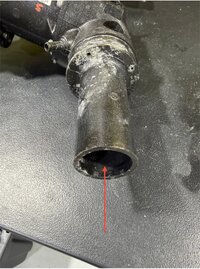
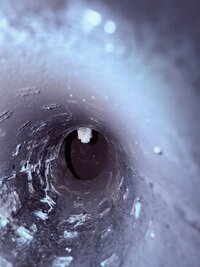
So you are saying in the picture below we are looking towards the engine and the cat?
1779478753586.jpeg
 
Confirmed with my friend, this is what he said when he saw the pictures.

Definitely raw water intrusion into that exhaust

It’s a grip for sure to get rid of the cat, but if it’s leaking can you even get the replacements? Seems like the best way to go would be to eliminate it with the straight pipe and the re flash.

So you are saying in the picture below we are looking towards the engine and the cat?
View attachment 245594
That is looking backwards from where the waterbox normally sits into the exhaust housing that has the cat in it... (let around the corner of that tube you see). That housing is raw water cooled. The raw water enters in the double walled exhaust system at the header, goes through the double walled cat housing and the exits at the end of the cat housing "around" the still "dry" exhaust stream into the waterbox... Here is a picture of how that looks:

IMG_0719.jpeg

The O2 sensor sits in the "hole" you see on the top, the raw water sprays form the 4 small holes around the center pipe piece, the pipe is the still dry exhaust stream. All together is inside the waterbed when installed. The clamp sits on the last piece of full diameter before the pipe gets smaller. . It's all very short, so that part of the exhaust ist basically constantly in a "raw water fog". Even on a brand new boat as far as I understand. While the boat is running, the exhaust pressure basically blows away that fog yet swirls will still be there (it blows into a box full of water) and the moment the engine stops, the warm/hot waterbox condensates in the actively cooled and therefore cooler exhaust housing. At least thats what I've been told and technically (I am an engineer) that makes total sense. So to sum this up, I think my scenario is possible without a leaking cat housing yet I can't rule that out completely yet.
 
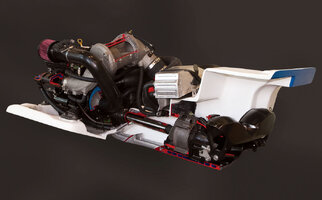
Here is a good picture of the Rotax JPS system with cutaways:

chaparral_203vortexvrx_engine_2014_big.jpg
 
Confirmed with my friend, this is what he said when he saw the pictures.

Definitely raw water intrusion into that exhaust

It’s a grip for sure to get rid of the cat, but if it’s leaking can you even get the replacements? Seems like the best way to go would be to eliminate it with the straight pipe and the re flash.

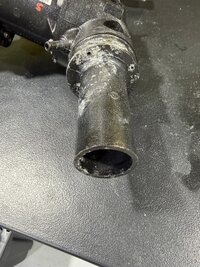
So you are saying in the picture below we are looking towards the engine and the cat?
View attachment 245594
So yes, this picture is looking towards the cat and the engine after that.

The camera is pointing the way the red arrow is pointing.
IMG_1351.jpeg
 
correct… and where the arrow ist, that black/cast exhaust piece is already “inside” the waterbox when installed (there is only a rubber coupler)
 
Update: new thermostat, charger serviced, new o2 sensors, all put back together, new brp original coolant (vacuum refilled)… runs good but still runs hot at wide open throttle… pulls harder, is fast (top speed 42mph) it seems but still got the boat to 219f coolant after maybe 10 min wot in 85f water and 90f ambient. charge air maxed out at 124f (which i think is ok). its really like chasing a ghost… i am tempted to replace the rideplate now :confused:
 
Update: new thermostat, charger serviced, new o2 sensors, all put back together, new brp original coolant (vacuum refilled)… runs good but still runs hot at wide open throttle… pulls harder, is fast (top speed 42mph) it seems but still got the boat to 219f coolant after maybe 10 min wot in 85f water and 90f ambient. charge air maxed out at 124f (which i think is ok). its really like chasing a ghost… i am tempted to replace the rideplate now :confused:
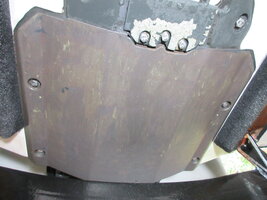
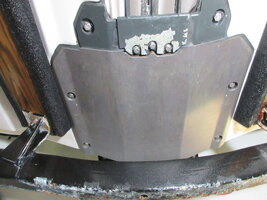
I had another thought on this. This is a heat transfer problem, and the heat needs to go out through the ride plate. Your image of the ride plate internal passages made me think that maybe the ride plate internals are not the issue. Maybe it’s the external surface. I’ve launched at ramps, that at times, have had slime on the surface of the water that stuck to the side of my boat. I worked to get that slime off of my nice white hull, but I can’t say that I put any real effort into making sure that it was off the ride plate. I thought that it was just an aesthetic issue. I’m starting to wonder if this baked on slime is what is inhibiting the heat transfer and causing my engine to run hotter. Last weekend I scrubbed (hard) the surface of the ride plate with a 3M Scotch-Brite pad and Dawn Platinum Plus Power Wash. This isn’t necessarily recommended maintenance, but I thought that it was worth trying before I replace my ride plate. I have attached the before and after pictures. I haven’t had a chance to test this out yet to see if it had any effect, but I wanted to share these thoughts with you, for your consideration, before you replace your ride plate.
 

Attachments

  • IMG_1004.JPG
    IMG_1004.JPG
    4.8 MB · Views: 4
  • IMG_1017.JPG
    IMG_1017.JPG
    4.9 MB · Views: 4
It certainly won't hurt. But nope lol. That is nowhere near enough to make a difference based on the before pic. Sorry.
 
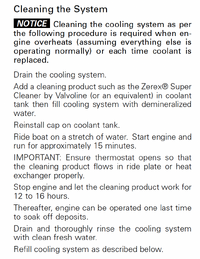
I did some extensive (yes, internet) "research" and it seems, the ride plates can build up "residue" which seems to inhibit proper heat transfer. I found stories of 255 with twin 250s, a 165 with a 250 and others... all the same issue: boat gets hotter at "wot" at only sub 100h of total runtime. And after doing what I did, they finally replaced the ride plate and finally the boat ran cool again. One guy opened the old plate and it was white "gunk" (only couple millimeter thin) on the lower part inside... The Rotax Service Manual even refers to "cleaning the cooling system" See screenshot). This got me thinking..... Maybe my next step!

1781054169338.png
We also scanned the boat today (buds) and compared to a 260hp SeaDoo ski my friend/mechanic had on the lot and he knew was "ran hard" by the owner. Maximum EGT and IAT where identical yet the ski maxed out at 209f coolant, I did 219f. Given EGT and IAT are "in shape" in my scenario, raw water cooling seems to work and intercooler does its job...
 
After a re read of the thread I see that that the boat sat for a year with what appears to be prestone / ethylene glycol anti freeze in it. Thats not necessarily a bad thing as Prestone is used in engines with dissimilar metals / materials and aluminum. Having said that, it appears even when using the manufacturer specified coolant there can still be a build up of heat transfer limiting spooge inside the ride plate which is your heat exchanger / radiator. This appears to be a known issue since the manual specifies the system to be cleaned when the coolant is replaced, or if there is an overheating issue and all components are working normally. Since the high temp alarm is still quite a ways away from where you’re at now it appears to me there’s a pretty wide band of normal temperature increase or range.

I would assume that the coolant returning from the ride plate / goes to the CAC first to cool the boosted air with the lowest temperature coolant. The intake air temperature sender is reading the temperature of this “cooled” air from the CAC that was heated by the supercharger. The cooler the intake air the more fuel will be delivered which is more power. I would also assume the cooler the intake air temperature would reduce combustion temperatures a bit as well. Thats good that you recorded the IAT temperature,124°, so you have another benchmark to track your results at this point.

By the way, Did you ever test your thermostat?

So with the advantage of hindsight, in my opinion anyway, the first thing to have done would have been to “clean” the cooling system, as everything else could have been operating normally. But, now with everything else being checked, replaced and rebuilt the last thing to do would be to clean the cooling system before removing and replacing the ride plate to see if that gets the engine temperatures back down to where they were before. If that works you’re off to the races and you can stop troubleshooting and working on your boat and can go out and use it with confidence and the knowledge you’ve done everything you can to make sure the engine is working like new.
 
Very much what my opinion is currently too... very well summed up ;-)

I will now try to do that "cleaning" and reached out to Valvoline and Rotax to see what product is recommendet asl "Zerex Super Clean" is discontinued as far as I can see.

To answer your question FSH: Yes, thermostat (old one) was checked, it worked. So that was replaced for no reason. While in there I did supercharger and carbon seal, lets consider that "preventive maintenance" ;-)
 
Very much what my opinion is currently too... very well summed up ;-)

I will now try to do that "cleaning" and reached out to Valvoline and Rotax to see what product is recommendet asl "Zerex Super Clean" is discontinued as far as I can see.

To answer your question FSH: Yes, thermostat (old one) was checked, it worked. So that was replaced for no reason. While in there I did supercharger and carbon seal, lets consider that "preventive maintenance" ;-)
Right on…. It’s always good to test old components to see if they were contributing to a problem. As I said above, you’ve done a bunch of pm work so you’re good to go.

There are a lot of radiator cleaners out there just have to find a good one. I liked the leaving it in there instructions for the zeroed and then running it again. Hopefully you can source one that will clean out the residue.
 
It certainly won't hurt. But nope lol. That is nowhere near enough to make a difference based on the before pic. Sorry.
Yup, that was a swing and a miss. Scrubbing the exterior of the ride plate had no significant impact on the engine temperature. The engine temperature is still 204F after fifteen minutes at 6500 rpm with a water temperature of 65F and air temperature of 85F.
 
Yup, that was a swing and a miss. Scrubbing the exterior of the ride plate had no significant impact on the engine temperature. The engine temperature is still 204F after fifteen minutes at 6500 rpm with a water temperature of 65F and air temperature of 85F.
Looks like you need to run a cleaner through your system as described above and that should solve your issues.
 
Valvoline Radiator Super Cleaner is available at Walmart, VP-001. Run it as described in der screenshot i posted from the service manual and give us a feedback pls… Haven't had a chance yet to do it myself but will do 4 sure soon
 
Last edited:
Zerex being a Valvoline brand its supposedly the “successor”
 
Back
Top