• Welcome to Jetboaters.net!

    We are delighted you have found your way to the best Jet Boaters Forum on the internet! Please consider Signing Up so that you can enjoy all the features and offers on the forum. We have members with boats from all the major manufacturers including Yamaha, Seadoo, Scarab and Chaparral. We don't email you SPAM, and the site is totally non-commercial. So what's to lose? IT IS FREE!

    Membership allows you to ask questions (no matter how mundane), meet up with other jet boaters, see full images (not just thumbnails), browse the member map and qualifies you for members only discounts offered by vendors who run specials for our members only! (It also gets rid of this banner!)

    free hit counter

2004 SX230 — port engine intermittent misfire, second SBT engine, please help

40sx230

Member
Messages
9
Reaction score
6
Points
12
Boat Make
Yamaha
Year
2004
Boat Model
SX
Boat Length
23
Looking for ideas. I’m out of them and SBT tech support said they don’t know either.
Boat: 2004 Yamaha SX230, twin SRT1000/MR-1 engines. Salt water occasional, mostly fresh.
History:
• First port engine cracked the block at the aft cylinder while running at 7k. SBT called it hydrolock. Replaced under warranty with second long block.
• Second engine ran clean for about an hour after install, then developed the symptom below.
Symptom:
• Port only. Starboard runs perfect.
• Intermittent misfire, sustained miss under load, intake popping
• Stalls at trolling speed, sometimes at any RPM, restarts instantly every time
• Heat-progressive — worse the longer it runs, but now showing cold too
• Sometimes clears when whacked to WOT, sometimes doesn’t
• All four cylinders affected equally — pulling either coil at idle causes equal RPM drop
• No fault codes in YDS. YDS data stays clean during events (no connection drops).
Eliminated by direct test:
• ECM (port-to-starboard swap, symptom stayed on port)
• Coils + plug wires (swap)
• Complete intake assembly — throttle bodies, TPS, IAP, IAT, fuel rail, all 4 injectors, intake harness section (full assembly swap, symptom stayed)
• Bulk fuel pressure (50 psi steady through the symptom — 3 psi over the 45-47 spec but didn’t sag)
• Compression (port and starboard test equivalent on same gauge, ~115-120 across all cylinders)
• Throttle body sync
• Static sensor readings between engines all match (TPS, IAP atmospheric, ECT, IAT, battery voltage)
• All four spark plugs replaced with new NGK CR9EB
• Every accessible connector cleaned with contact cleaner and dielectric grease
• Engine grounds, battery terminals, main 20A fuse contacts
• Visual inspection of intake risers/boots and clamps
Replaced as part of the new long block:
• Pulser coil, stator, regulator/rectifier, oil pump, all sensors except cam
• Cam position sensor replaced separately afterward (didn’t fix)
• Exhaust manifolds and elbows replaced with used freshwater units before second engine
Transferred from first failed engine:
• Flywheel/rotor (with new key per SBT)
• Crank pulley
• Starter, mounts
Other notes:
• Live ignition timing on YDS shows port commanding slightly higher than starboard at matched RPM (33° vs 24° at 3k on trailer) — but conditions weren’t perfectly matched between engines so unclear if real
• Pisser stream weak/absent on port has been the case since I bought the boat — pre-existing condition unrelated to current symptom
• Two local marine shops won’t take boats older than 2010
Things I haven’t done:
• Pull valve cover (voids SBT warranty — though SBT has effectively walked away)
• Leak-down test (compression equivalent suggests not the issue)
• Fuel pump volume test or pump swap
• Helm wiring inspection
Has anyone seen this exact pattern? Two SBT engines in a row with port-side issues makes me think it’s something on the boat killing or stressing engines, but I can’t find what.
Open to anything. Thanks.
 
Looking for ideas. I’m out of them and SBT tech support said they don’t know either.
Boat: 2004 Yamaha SX230, twin SRT1000/MR-1 engines. Salt water occasional, mostly fresh.
History:
• First port engine cracked the block at the aft cylinder while running at 7k. SBT called it hydrolock. Replaced under warranty with second long block.
• Second engine ran clean for about an hour after install, then developed the symptom below.
Symptom:
• Port only. Starboard runs perfect.
• Intermittent misfire, sustained miss under load, intake popping
• Stalls at trolling speed, sometimes at any RPM, restarts instantly every time
• Heat-progressive — worse the longer it runs, but now showing cold too
• Sometimes clears when whacked to WOT, sometimes doesn’t
• All four cylinders affected equally — pulling either coil at idle causes equal RPM drop
• No fault codes in YDS. YDS data stays clean during events (no connection drops).
Eliminated by direct test:
• ECM (port-to-starboard swap, symptom stayed on port)
• Coils + plug wires (swap)
• Complete intake assembly — throttle bodies, TPS, IAP, IAT, fuel rail, all 4 injectors, intake harness section (full assembly swap, symptom stayed)
• Bulk fuel pressure (50 psi steady through the symptom — 3 psi over the 45-47 spec but didn’t sag)
• Compression (port and starboard test equivalent on same gauge, ~115-120 across all cylinders)
• Throttle body sync
• Static sensor readings between engines all match (TPS, IAP atmospheric, ECT, IAT, battery voltage)
• All four spark plugs replaced with new NGK CR9EB
• Every accessible connector cleaned with contact cleaner and dielectric grease
• Engine grounds, battery terminals, main 20A fuse contacts
• Visual inspection of intake risers/boots and clamps
Replaced as part of the new long block:
• Pulser coil, stator, regulator/rectifier, oil pump, all sensors except cam
• Cam position sensor replaced separately afterward (didn’t fix)
• Exhaust manifolds and elbows replaced with used freshwater units before second engine
Transferred from first failed engine:
• Flywheel/rotor (with new key per SBT)
• Crank pulley
• Starter, mounts
Other notes:
• Live ignition timing on YDS shows port commanding slightly higher than starboard at matched RPM (33° vs 24° at 3k on trailer) — but conditions weren’t perfectly matched between engines so unclear if real
• Pisser stream weak/absent on port has been the case since I bought the boat — pre-existing condition unrelated to current symptom
• Two local marine shops won’t take boats older than 2010
Things I haven’t done:
• Pull valve cover (voids SBT warranty — though SBT has effectively walked away)
• Leak-down test (compression equivalent suggests not the issue)
• Fuel pump volume test or pump swap
• Helm wiring inspection
Has anyone seen this exact pattern? Two SBT engines in a row with port-side issues makes me think it’s something on the boat killing or stressing engines, but I can’t find what.
Open to anything. Thanks.
First off 115 to 120 psi is way too low. Did you check the compression on the good running engine to compare. Inless the gauge sucks that isn't right. Should be 175psi to 200. Do a compression test with the throttle bodies open fully
Do a leak down check. Its the only true way to make sure the condition of the compression chamber.
Sbt hasn't been on par the last few years
 
The timing difference seems significant to me.

That said, my vote is for a valve problem, sticky perhaps.
 
First off 115 to 120 psi is way too low. Did you check the compression on the good running engine to compare. Inless the gauge sucks that isn't right. Should be 175psi to 200. Do a compression test with the throttle bodies open fully
Do a leak down check. Its the only true way to make sure the condition of the compression chamber.
Sbt hasn't been on par the last few years

Thanks for the response. I tested both engines back-to-back with the same gauge, same procedure, throttle wide open, all four plugs out, fresh battery. Port and starboard came back essentially identical (port averaged ~117 psi, starboard ~118 psi, all cylinders within 7 psi of each other).
Starboard runs perfect and pulls the boat to full RPM normally — it can’t actually have 118 psi compression and do that? So I’m reading this as the gauge is reading low (it was a Harbor Freight cheapo one, which apparently have a known reputation for reading roughly half of actual). The port-vs-starboard comparison being equivalent on the same gauge is what tells me the long block isn’t the issue mechanically.
Agreed on doing a leak-down test as the next move. Looking into getting that done. Also agreed that SBT QC has slipped — the fact that I’m on my second engine from them tells me that.
 
I had a customers 242 limited that would stumble and miss on one engine at different times, usually when hot. I did what you did and swapped everything from engines. Turned out to be a faulty wire in the harness in the bulk of the wires neat the ecu box. Could not isolate which wire or wires. Replaced the harness and problem never returned
 
I had a customers 242 limited that would stumble and miss on one engine at different times, usually when hot. I did what you did and swapped everything from engines. Turned out to be a faulty wire in the harness in the bulk of the wires neat the ecu box. Could not isolate which wire or wires. Replaced the harness
This sounds exactly like what I’m dealing with — same intermittent pattern, heat-progressive, couldn’t isolate. Thank you, this is the most useful lead I’ve gotten.
Few questions:
• Did you replace just the engine harness section, or the whole boat harness? Did it fail a wiggle test? I wiggle and can’t make it act up.
• Where specifically near the ECU box did you suspect the damage was — chafing, internal break, something else?
• Did the customer mention any history that might explain harness damage (rodent damage, previous engine work, water intrusion to the harness loom)?
• Roughly what did the harness replacement cost?
Trying to figure out if I should pursue this myself. Have you seen this same failure on other MR-1s or was that 242 a one-off?
 
Customer had bought the boat used, the engine with the faulty harness was replaced prior to him purchasing it. My guess is it was damaged during the engine removal.
I didn't see the damaged harness. The Customer bought the harness and replaced it himself. I could never get it to act up just by the wiggle test.
But it was all that was left.
My guess was there was something in the large bulk of wire going into the ecu.
The engine harness was replaced.

Had a 2024 waverunner the other day that would stall randomly that one had a bad wire in the harness going to the ecu right at the connector. Depinned and replace a 6 inch section of that wire. You could see a strange bend in that wire where it entered the harness.
That one would stall when you touched that wire.

Its time consuming but you can carefully swap the harness see if it moves
 
This is incredibly helpful, thank you. The engine removal damage theory makes sense — my port has been pulled and replaced twice (first SBT engine cracked the block, second one is the current one). Plenty of opportunity for harness damage during those R&Rs.
The 2024 waverunner detail is interesting — “strange bend where it entered the harness” gives me something specific to look for. I’ll go back and look closely at the port harness right at the ECU connector exit point for any bent or stressed-looking wire.

I’m going to take the harness out and look for any issues. I will report back with an update. Thank you again!!
 
This is incredibly helpful, thank you. The engine removal damage theory makes sense — my port has been pulled and replaced twice (first SBT engine cracked the block, second one is the current one). Plenty of opportunity for harness damage during those R&Rs.
The 2024 waverunner detail is interesting — “strange bend where it entered the harness” gives me something specific to look for. I’ll go back and look closely at the port harness right at the ECU connector exit point for any bent or stressed-looking wire.

I’m going to take the harness out and look for any issues. I will report back with an update. Thank you again!!
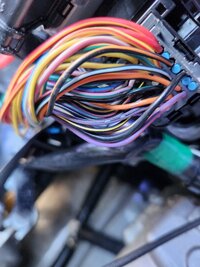
The pink wire with the green stripe
20260504_102856.jpg
 
I had a customers 242 limited that would stumble and miss on one engine at different times, usually when hot. I did what you did and swapped everything from engines. Turned out to be a faulty wire in the harness in the bulk of the wires neat the ecu box. Could not isolate which wire or wires. Replaced the harness

The pink wire with the green stripe
View attachment 245184
Holy crap, that’s the IAP signal wire (pin 19 from the ECM, P/G goes to the intake air pressure sensor per my service manual). That would explain literally every symptom — misfire under load from wrong fuel/timing calculation, heat-progressive, no YDS code because IAP would still report a valid voltage range, all four cylinders affected equally, can’t be fixed by ECM swap or intake swap because the damaged wire sits between them.
I’m going back to look at that specific wire right now. Going to check it for a strange bend at the connector exit, and continuity test it under flex.
Thank you — this might actually be it.
 
Doubt its the same wire for your boat. This is the new style ecu on a 2024 Gp1800 svho.
These have the 2 new style 33pin(i believe) connectors that have rectangular slots.
Color and pin placement will not be tha same
 
Before you completely remove the harness, can you unplug all the ends and test continuity on each wire? This will allow you to flex the wires more without going to the trouble of completely removing it. It's possible that some wires will have splices in the harness and each end may be a different color.
 
Doubt its the same wire for your boat. This is the new style ecu on a 2024 Gp1800 svho.
These have the 2 new style 33pin(i believe) connectors that have rectangular slots.
Color and pin placement will not be tha same
Quick update for anyone following along.
Did since last post:
• Pulled the engine harness (90% out, kept helm wire run intact)
• Visually inspected every section, especially the bulk near the ECU connector where the bend damage was suspected
• Tested every signal wire and power/ground wire end-to-end with a multimeter using alligator clips and proper baseline subtraction (~0.4 ohm baseline today)
• All wires read at baseline including: P/G (IAP), W/R and W/B (both pulser signals), G/O (cam), B/Y (engine temp), Y, P (TPS), B/O (sensor common ground), L/R (ECM power), B (ECM ground tested through harness, engine block, and to battery), all four coil trigger wires
• Cleaned and reseated every connector along the way
• Reassembled
• Tested at the ramp — symptom returned
• Swapped fuel pumps port to starboard — symptom still on port
Cleared by direct test now (full list):
• ECU (swap)
• Coils + wires (swap)
• Complete intake assembly: throttle bodies, TPS, IAP, IAT, fuel rail, all 4 injectors, intake harness section (full assembly swap)
• Fuel pumps (just swap-tested)
• Bulk fuel pressure (50 psi steady)
• Compression (equivalent both engines)
• Spark plugs (replaced new NGK CR9EB)
• Every accessible connection (cleaned)
• Every signal wire and ground in engine harness (continuity tested end-to-end)
• ECM main power and ground (continuity verified)
• All four coil output wires
• Throttle body sync
• Static sensor readings (all match starboard)
Where I’m at:
Symptom unchanged. Engine will idle clean for a while, then randomly stall. At RPM it bogs/surges first and then can stall after the bog. Sometimes clears at WOT. Restarts immediately every time. No fault codes. YDS data either stays clean or briefly freezes during the event.
Realistically remaining suspects:
1. Internal harness damage that doesn’t show on continuity testing under static conditions (consistent with the 242 case mentioned earlier in this thread where replacement fixed it without finding specific damage)
2. Mechanical inside the engine — valve clearance or cam timing from SBT’s build
3. Something specific to the boat itself causing repeat port-side engine problems
SBT tech support told me they don’t know and that I’ve done everything. Two local marine shops won’t take the boat (older than 2010 cutoff).
Looking for:
• Anyone in Florida (I’m in Arcadia) who knows a Yamaha-experienced shop or independent mechanic that’ll work on a 2004 SX230
• Thoughts on whether to pull the valve cover myself (warranty is functionally worthless given SBT’s response) vs commit to a harness replacement on speculation
• Anyone who’s run into the “two engines in a row on the same side” pattern and figured out what was on the boat causing it
Open to suggestions. Tired of the back of this engine bay but not ready to give up.
 
The first SBT engine ran well until it 'hydrolocked'? Did you see where it was cracked? I don't know how an engine hydrolocks while running at 7K, even if it blows the head gasket or something. (I've heard of dragster engines exploding due to raw fuel in the cylinder if the spark fails, but that's totally different).

The fact that it's 'popping' out the intake suggests a valve timing issue or sticking intake valve. I wonder if there is a is a problem with the timing chain or tensioner. OR, it could be an ignition timing problem. When you swapped coils, did you swap them with the other engine, or just between cylinders? You say you 'cleared by direct test' the coil output wires (spark plug wires). What does that mean? Sometimes one wire can arc or induce voltage into an adjacent wire. Have you tried starting it at night (total darkness) to see if any of the wires are arcing or glowing?
 
The first SBT engine ran well until it 'hydrolocked'? Did you see where it was cracked? I don't know how an engine hydrolocks while running at 7K, even if it blows the head gasket or something. (I've heard of dragster engines exploding due to raw fuel in the cylinder if the spark fails, but that's totally different).

The fact that it's 'popping' out the intake suggests a valve timing issue or sticking intake valve. I wonder if there is a is a problem with the timing chain or tensioner. OR, it could be an ignition timing problem. When you swapped coils, did you swap them with the other engine, or just between cylinders? You say you 'cleared by direct test' the coil output wires (spark plug wires). What does that mean? Sometimes one wire can arc or induce voltage into an adjacent wire. Have you tried starting it at night (total darkness) to see if any of the wires are arcing or glowing?
I'm leaning more toward ignition at this point. Maybe a pulser coil with an issue that won't show up on an ohm test — it tests within spec (459-561Ω range), but that doesn't catch marginal signal output under load or heat-sensitive failures.

Plan is to swap the whole electrical box port to starboard first as a swap test on relays, fuses, and the wiring up to that point. If symptom is still there after that, I'm pulling the front cover and swapping the whole stator/pulser assembly port to starboard. Major job since the power unit has to come out on this engine to get the front cover off, but at this point it's the only way to definitively rule the pulser in or out.

For the coil swap I did earlier — that was port-to-starboard, full coil and plug wire moved engine to engine, not just cylinder to cylinder. Symptom stayed on port so coils confirmed cleared.

Coil output wires "cleared by direct test" meant I did continuity testing on the 4 trigger wires from ECM pins to coil connectors with proper baseline subtraction. All read at baseline, no resistance issues. That tested the trigger signal path from ECM to coil — separate from testing the coils themselves or the high-voltage side.

Haven't done the night arcing test yet — great suggestion, will run it next time I have it heat-soaked and acting up.

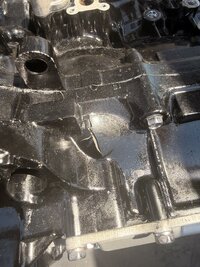
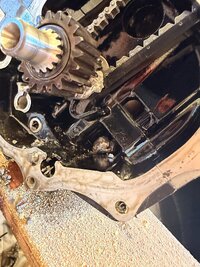
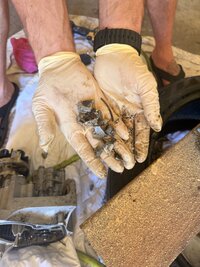
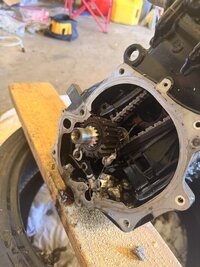
Attaching some pics of the engine. Not in photos but it bent a bunch of valves to, with valves being bennt i think it dropped a valve or something.
 

Attachments

  • IMG_1899.jpeg
    IMG_1899.jpeg
    2.4 MB · Views: 9
  • IMG_1896.jpeg
    IMG_1896.jpeg
    2.1 MB · Views: 8
  • IMG_1895.jpeg
    IMG_1895.jpeg
    2.6 MB · Views: 9
  • IMG_1891.jpeg
    IMG_1891.jpeg
    2.5 MB · Views: 9
Bent valves? I don't think hydrolocking would do that. Sounds like the timing chain jumped. Stretched chain or bad tensioner.
 
im not to sure as I did not take the engine apart. But definitely something like that. Not a hydrolock from anything I’ve seen in my life.
Bent valves? I don't think hydrolocking would do that. Sounds like the timing chain jumped. Stretched chain or bad tensioner.
 
Subject: FOUND IT — loose ground on the oil tank
Closing this out for anyone who finds the thread later.
It was a loose ground — and the mistake was mine.
The black-with-orange-stripe (B/O) sensor common ground wire terminates on a bolted ring terminal at the oil cooler/tank. On port engine, that bolt was loose. Not visibly compromised, no obvious corrosion — just not torqued tight.
That ground bolt was disturbed during R&R when I pulled the first engine that cracked the block, and I never got it properly torqued back down when I installed the second engine. It sat loose this entire time.
That single ground connection is the shared reference for multiple sensors on the engine. When it was loose:
• Sensor readings shifted around the bad ground reference
• ECM saw “valid” voltages so no fault codes
• Symptoms were random, intermittent, heat-progressive (loose bolt expanded with heat making contact worse)
• Survived every swap test because the bolt stayed with port engine
• Continuity testing passed because probe pressure mimicked good contact
• Hidden in plain sight because it’s not a connector you check during normal connector cleaning
Cleaned both contact surfaces to bare metal, torqued the bolt, dielectric grease over the joint. Ran 20 minutes on the hose at varied RPM. Zero skip. Pure excellence.
Lessons for anyone hunting the same symptoms:
1. If you’ve had the engine out for any reason, double-check every grounded ring terminal you may have disturbed. The shared sensor ground terminations on the oil tank, exhaust manifold bolts, and similar are easy to miss because they’re not part of the obvious connector list.
2. A loose ground produces symptoms that look like everything except a ground problem. No codes, sensor readings appear fine, every swap test fails to move the symptom, every wire tests good with continuity.
3. The two-engine pattern may have been the same root cause all along. Wrong sensor ground reference → wrong fuel/timing → potential detonation event → cracked block on the first engine. The harness was never the problem. The ground point was.
4. Take photos before engine R&R and use a checklist on reinstall. I thought I had everything covered. I didn’t.
Thanks to everyone who chimed in with theories and pushed me to keep looking. Special thanks to the tech who described the 242 harness case — even though the harness wasn’t it, the idea to swap the harness’s led me to the loose bolt when I finally inspected that area.
Going to do a real water test next ramp trip to confirm under load, but tonight on hose this thing ran perfect.
 
Back
Top