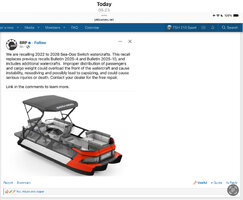
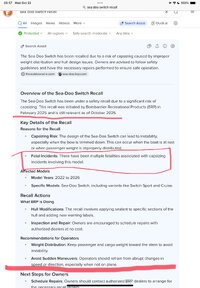
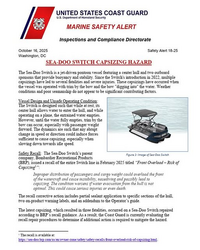
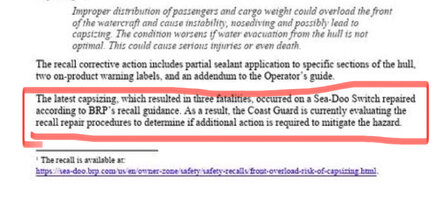
The US coastguard used some confusing wording in the recall unfortunately.
"The Switch is
designed such that its center hull allows water to enter the hull, and while operating on a plane, the entrained water empties."
This implies the designer intended the boat to use water for ballast in the center hull (like a controlled system), which is
not true. In all the incidents I read the boats were also overloaded and there was operator error involved despite how the incidents are being summarized. In some they were under the passenger count but well over the cargo capacity and it seem like people don't understand that both limits apply. Not disputing that there is a manufacturing process defect that needs to be corrected. The underlying design basis holds (I searched and could find nothing stating an issue with the design basis for the Switch). There is some debate over whether the Switch meets the classification criteria to be called a tritoon. The
sponsons are set slightely higher and
designed to allow allow water ingress and egress (not the center pontoon) for the purpose of dynamic stability.
Here are some snippets from information I was able to find concering the incidents:
"....capacity According to the DNR, the manufacturer specified a limit of 705 pounds. The four adults weighed a total of 820 pounds, according to drivers license data.
However, an operators manual lists the max weight as 825 pounds.
The children had been towed in a tube on the way to the restaurant, during which speeds of up to 21 mph were recorded. Their return vovage was after dark, so the children had to be aboard and would have have added even more weight toward the stated capacity.
Hussain, like the father in the Florida case, was not an experienced boater. DNR officers learned that he had not taken an approved boater education course, but Hussain said he had taken private lessons from Belle Haven Marina in Alexandria.” (Both accidents in question involved the 13-foot, five-person model.)"
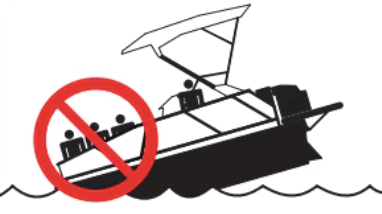
Anyway you get the idea - there was a lot more to the story in all the incidents I was able to track down - which is pretty common. The investigators did not seem account for the weight of the gear/coolers/etc. which often adds up quickly. Also remember the compact a 13' boat! Even the 18' boat only hs a 16' hull and our 21' is really only a 19' boat so people need to really pay attention to the nameplate capacities. Part of the problem is there is space for a lot of people to physically sit on these boats - more so than most other boats. No way should anyone put 10 adults on any of these boats plus gear.
I plan to operate our boat with an additional factor of safety, just like I do when we haul a trailer (need to be under the GCWR, GVWR, GAWR, and have atleast 10% tongue weight). The safety margin was reduced by this defect. In several cases, overloading the bow with weight—whether passengers or gear—exacerbated the issue, but this became deadly because of the underlying defect that trapped water inside the hull. These tragedies highlight why an official recall was necessary, even if operator actions also contributed. The sad part is this a tragic event for the families involved and my heart goes out to them for their loss. I'm sure the 400 people employed at the Sturtevant plant are worried too.
Anyway - just posting for those that are interested in the rationale behind what I stated and really don't want to argue. I did my homework, and until advised otherwise by the regulator, the mandatory gasket fix addresses the root cause of the contibuting factor in the boat itself. This issue is being broadly misrepresented within the media and on forums like this one. Here is the link to the TC recall which seems to be a little clearer but still confusing for me at least:
Safety recall – Sea-Doo Switch